Month: April 2020

Using Wall Decals to Promote 2D Processing

This post contains affiliate links. As an Amazon Associate, I earn from qualifying purchases at no cost to you.

Happy CVI Literacy Awareness Month!

When it comes to Cortical Visual Impairment (CVI) and literacy, it’s important to understand that anything we do to promote looking, visually recognizing, and interpreting what the eyes are seeing is creating a path to literacy. 

What do I mean by this?

To briefly summarize: CVI is a brain-based vision impairment. The eyes are healthy and function normally, but the brain has difficulty processing and understanding what the eyes see. But, how an individual with CVI uses and functions with their vision can improve as the brain makes new connections, learning to recognize and better interpret more visual input.

So, if you think about it, literally any time we get a child with CVI “looking” we are working towards literacy. A child must be able to look at something, maintain visual focus, and begin recognizing and interpreting what they are looking at in order to achieve literacy.

Keeping this in mind, I am always looking for creative ways to increase my daughter’s opportunities to use her vision throughout our everyday routines. Right now this means creating additional ways to get my daughter, Rosalie, looking at (and recognizing) more 2D images.

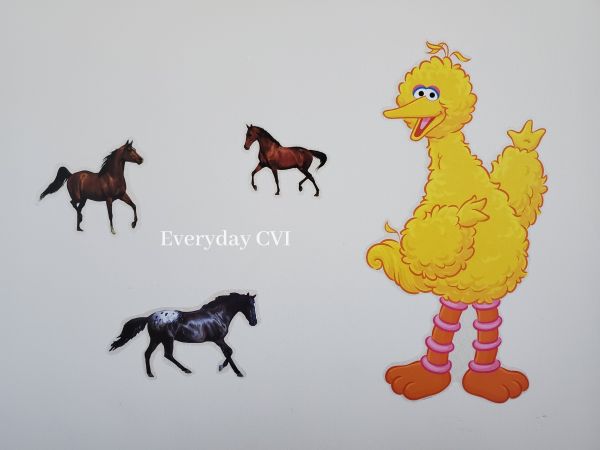
A recent strategy I’ve been using to promote extra 2D processing is: using wall decals around the house!
Big Bird2-wm

(more…)

CVI Strategies for Reading “Brown Bear, Brown Bear”

This post contains affiliate links. As an Amazon Associate, I earn from qualifying purchases at no cost to you.

In honor of CVI Literacy Awareness Month, I’d like to share some of the strategies I’ve used to introduce my daughter with Cortical Visual Impairment to the book Brown Bear, Brown Bear, What Do You See? by Bill Martin, Jr.

When I added a felt wall to my daughter’s defined play space, my mom gifted me a set of pre-cut Brown Bear felt pieces. I had fun immediately introducing the matching felt pieces to the pages in the story, which provided a fun tactile (and visual, obviously) learning experience.

Brown Bear-wm

Pictured above are all of the animals from the book, but to address the CVI characteristic of “complexity” I present only one image on the felt wall at a time.

(more…)

April is CVI Literacy Awareness Month!

Happy CVI Literacy Awareness Month!

The topic of literacy is so important for the CVI community that it needs its own month (set apart from CVI Awareness Month in September) for recognition and awareness. After all, a path to literacy for an individual with CVI must look different than a path to literacy for an individual with any other type of vision impairment. Why? Because CVI is unlike any other vision impairment. With this neurological-based vision impairment, the eyes are healthy and see what everyone else sees, but the brain has difficulty processing, recognizing, and interpreting what the eyes can see.

April (1)

In other words, CVI is a disability of visual access. Appropriate strategies that adapt the environment and materials in consideration of the 10 characteristics of CVI and an individual’s unique functional vision are the key to providing access to materials. This is no different when it comes to literacy.

Literacy is defined as “the ability to identify, understand, interpret, create, communicate and compute, using printed and written materials associated with varying contexts.” (UNESCO Education Sector, 2004, p. 13)

(more…)