Month: October 2018

Happy Halloween (with a little CVI adaptation)!

Happy Halloween! I have a handful of upcoming posts that I have not yet had time to finish, but I figured I would at least pop in to share one special way I have incorporated Cortical Visual Impairment (CVI) into our family’s Halloween decorations this year.

My husband and I began a yearly tradition of visiting a pumpkin patch (or, during the busiest years, a store that sells pumpkins) and painting a pumpkin for each person in our family. We were unable to paint pumpkins last year because we were a little bit busy with a certain newborn (cough, Rosalie), but we managed to resume the tradition this year – hooray!

I always get to paint the baby’s pumpkin, so you’d better believe I wasn’t going to miss this opportunity to advocate and raise awareness for my daughter! Check out how I painted Rosalie’s pumpkin:

Pumpkin-wm

Pictured on the front is clearly Rosalie’s initial…but I took advantage of Halloween’s CVI-friendly color scheme to highlight an adaptation for teaching a child with CVI how to read! The black background with a white letter surrounded by a bubble of bright, high-contrast color (like orange) is a key adaptation that – paired with appropriate descriptive language – can help a child with CVI begin to see the salient features of a letter (or word’s) shape.

And check out how I managed to sneak in a little extra CVI advocacy on the back….

Pumpkin2-wm

Pumpkin3-wm
#EverydayCVI #StartSeeingCVI #CorticalVisualImpairment #CVI

Rosalie is only a year old and will stay home while her big brothers go out trick-or-treating, so we do not yet have to worry about the complexity and sensory array of costumes or trick-or-treating (thank Goodness). But, for future reference I would love to learn about your own Halloween-related CVI adaptations!
Bath Time Adaptations

When I first learned of my daughter’s Cortical Visual Impairment (CVI) diagnosis I began strategically implementing at least one visual adaptation to every aspect of her daily life. The only thing I could initially think of for her bath time was to show her the red Elmo faucet cover (describing what it was and what we were about to do), and then place it on the edge of the bathtub so she could (maybe/hopefully) see it while I washed her.

We now know (thanks to Rosalie’s latest follow-up CVI Range performed by a Perkins-Roman CVI Range Endorsee) that Rosalie has made great strides with her vision in recent months and is more solidly in Phase II (hooray for big progress!). Phase I is all about building visual behaviors and ultimately getting a child to “simply” LOOK. But in Phase II we are seriously integrating vision with function, which means I have taken everything to the “next level” in terms of functionality. It’s no longer enough to JUST get her looking, but now whatever she is looking at needs to be even more meaningful; it needs to make sense within the context of whatever she is doing (for additional explanations of the 3 phases of CVI and what kinds of environmental supports are required within each phase, check out this instructional piece written by Ellen Cadigan Mazel, a teacher of the visually impaired and CVI Endorsed Professional who blogs at CVI Teacher).

So what else have I done to further adapt bath time, focusing on integrating vision with function?

Three simple things:

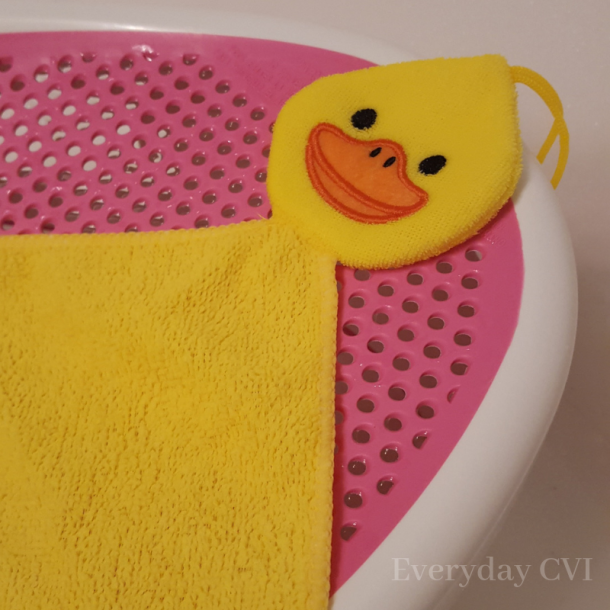
First, I have been using a bright yellow washcloth.

Bath4-wm

(more…)

Georgia Aquarium: CVI-Friendly Family Fun

I love visiting aquariums. And considering my husband’s first dream job as a child was to become a marine biologist, it’s safe to say he likes them, too. We first explored the Georgia Aquarium when we attended a friend’s wedding in Atlanta back in 2014, and it quickly became one of our favorites – mostly because it is the only aquarium in the Western Hemisphere that has whale sharks(!), but also because it is a great aquarium all-around. So, as soon as we moved within 7 hours of Atlanta a couple of years ago my husband began plotting our eventual return with the kids….

When our daughter, Rosalie (who has congenital hydrocephalus and CVI), was born we necessarily stuck very close to home (and our hospital) for a long time. Once she remained surgery-free for awhile and things seemed stable with her shunt we carefully eased ourselves back into travel with a few weekend trips in-state, no more than 2-3 hours away.

Last month, when Rosalie was 11 months old, we did our first out-of-state travel as a family of 5 because I was the Matron of Honor in my best friend’s wedding. The fact that Atlanta was the halfway point on our road trip sealed the deal: we could finally take the kids to the Georgia Aquarium!

Aquarium8-wm
Whale shark sighting!

Because Rosalie is so young, we do not yet plan family outings “for” her; instead, we do things geared towards her big brothers’ interests and abilities – as long as it can accommodate Rosalie’s needs and not overwhelm or scare her.

I had heard that aquariums tend to be a favorite of kids with CVI – with their low lighting contrasted by luminous tanks, brimming with highly-saturated hues of marine creatures. This is not unlike the reason why iPads, with their back-lit screens, can be so beneficial for visual attention in children with CVI.

(more…)

Creating Defined Spaces for Play

Within days of receiving Rosalie’s CVI diagnosis I made a mental list of all the places she regularly spends time (the crib, high chair, car seat, bathtub, etc.) so I could think of how to make those spaces more visually accessible to her (which you can read more about here). We were very home-bound when she was little, due to many factors relating to medical complications combined with my sheer terror when I thought about the possibility of her (or her big brothers!) getting sick that fall/winter/spring. But, because Rosalie has two big brothers we necessarily spent a great deal of time engaged in free play throughout the house.

We clearly have two spaces in which the boys regularly play, depending on what time of day it is: the designated play room (located upstairs) and the living room (located downstairs near the kitchen). These were the two rooms in which I would spread out a big baby blanket and create a “play space” for Rosalie as she grew, so the obvious next step after learning about her CVI was to make both of those baby play spaces easier for her to see. I really don’t think I had even learned the visual term “defined spaces” yet, but it made perfect sense to minimize the complexity of these spots where I would regularly lay her down with some toys.

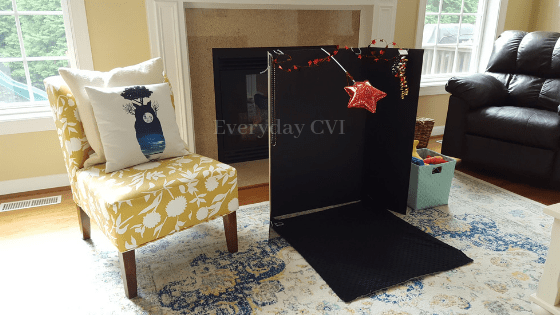
The living room was pretty easy, because I had already naturally carved out a little safe space for Rosalie where her brothers quickly learned to stop running, slow down, and be extra careful (we had made strict rules early on about not getting on her baby blanket without asking my husband or me). So, all I needed to do was trade out the blanket for one that is solid black (which I purchased on Amazon). Then, I placed a black tri-fold “science fair” board near the blanket so we could minimize complexity while she was side-lying or doing tummy time.

Dedicated Space9

Since Rosalie was 7 months old when we received her CVI diagnosis she had long out-grown our “real” baby play mat that came with hanging toy attachments, but her CVI meant that she really needed to have things hanging above her that she could practice looking at. She was not yet mobile (she had started rolling to her sides and a little bit onto her stomach), so having things hanging above one space where she could not move from was an important way to integrate vision into her play time.

(more…)